
Horse riding · Scotland
Horse Riding in Scottish Borders
You ride the Scottish Borders on waymarked horse routes, old drove roads and quiet forest tracks over rolling hills. Scottish Borders Council lists 14 routes, so the area suits riders from novice to expert.
At a glance
The short answer
- Best monthsMay to Sep
- Riding level
Novice on gentle routes to expert on the hills - TerrainRolling grassy hills, forest tracks, drove roads and disused railway lines
- Where to rideThe Cheviots, Tweed valley, Bowmont, Cloich and Hartwoodmyres forests
- AccessRight of responsible access under the Land Reform (Scotland) Act
- Long-distance routeCross Borders Drove Road, 82 km, ending at Hawick
- Stay with your horseCheck stabling or turnout, grazing and lorry parking before you book
Where to ride
Where to ride in the Scottish Borders
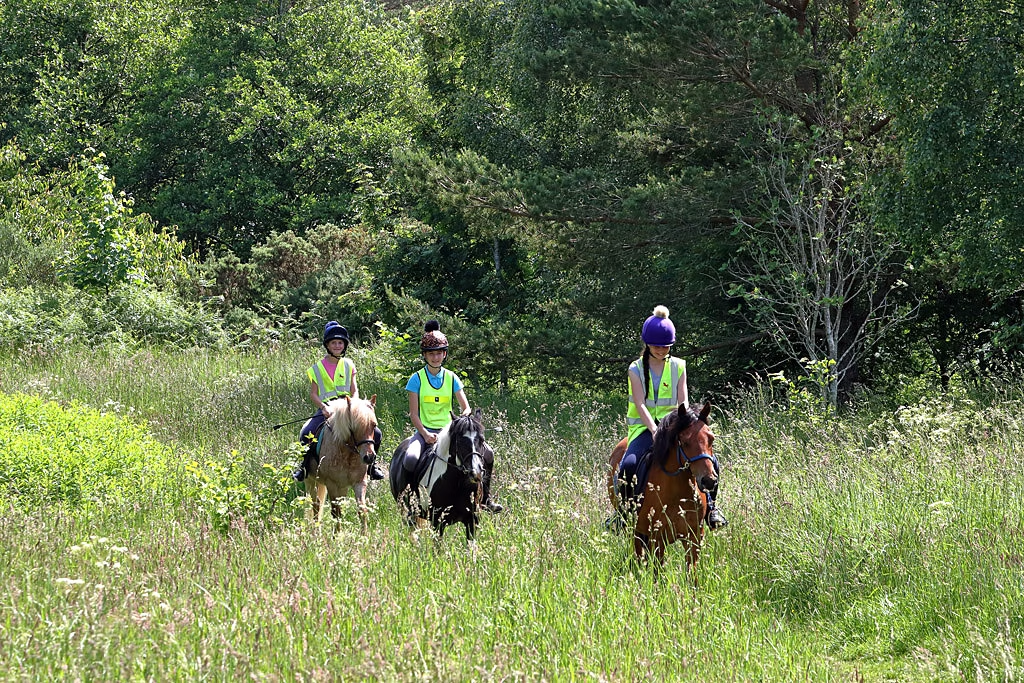
You can ride on waymarked horse routes, drove roads, forest tracks and disused railway lines across the Scottish Borders, with the Cheviots and the Tweed valley at the centre.
Scottish Borders Council published a leaflet of 14 waymarked horse routes, from 4.4 miles at the Hirsel and the Tweed to 54 miles on the Cross Borders Drove Road. It describes over 500 km of wide, open, grassy, rolling hills and hundreds of square kilometres of quiet forest, woodland, lochs and rivers.
Its routes run through forests including Bowmont, Hartwoodmyres and Cloich, along old drove roads and on disused railways, and they cover the Cheviots and the Pentland Hills.
The Southern Uplands Partnership says an earlier project put in place 350 km of waymarked routes suitable for riders, connecting northern England through to Biggar and Dumfries and Galloway. Its route maps include guidance on skill level.
Rights and rules
The rules for riding in the Scottish Borders
The rules are the Scottish ones. The Land Reform (Scotland) Act gives everyone a right of responsible access, and the Scottish Outdoor Access Code says that access rights extend to horse riding.
The Code says riding on wide paths, tracks and well-drained ground causes few problems. If you ride off the path in winter, it asks you to avoid wet, boggy or soft ground and not to churn up the surface.
Access rights do not apply to houses and gardens, or to land in which crops are growing. The Code asks you to keep to a walk near livestock and to stay out of fields with grazing horses or animals that might be a danger. You need permission for repetitive schooling, jumps or gallops on someone else's land.
The council's leaflet asks riders to follow the Code and to pass pedestrians at walking pace, because some people are nervous of horses. It also asks you to remove dung from parking areas, leave gates as you find them, avoid grassy paths in wet weather and keep dogs under close control. It says not to jump hedges.
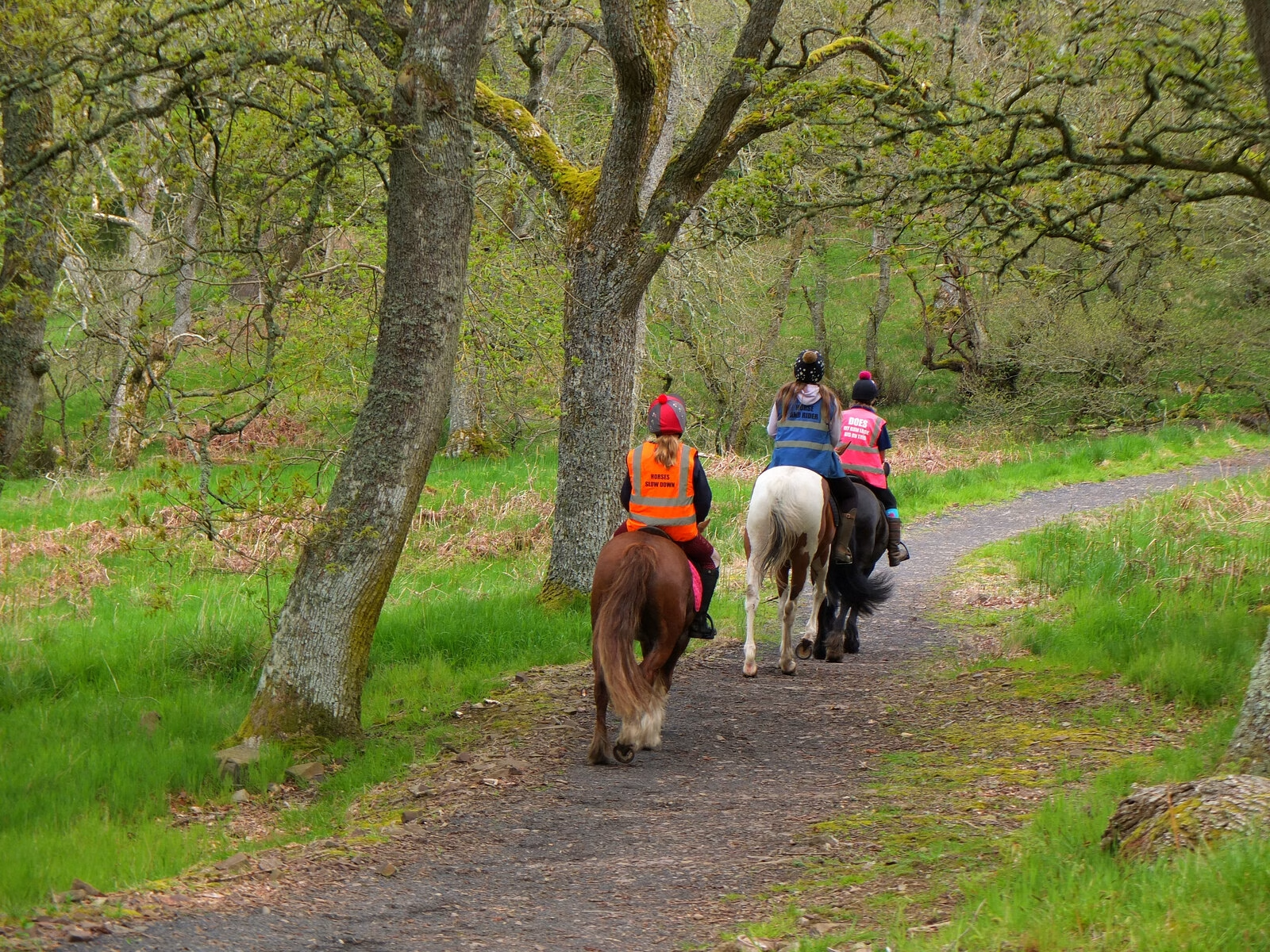
In forests, the British Horse Society Scotland advises high-visibility clothing wherever anyone may be shooting, felling or extracting timber. Forestry and Land Scotland asks you to take horse dung home from its car parks and, on a trail, to dismount and kick it to the side.
Long-distance routes
Long-distance routes for riders in the Scottish Borders
Yes, the Cross Borders Drove Road, whose facilities were designed specifically to accommodate horse riders as well as walkers.
Cross Borders Drove Road
Borders Abbeys Way
St Cuthbert's Way
Southern Upland Way
Scotland's national trails site gives its length as 82 km from Little Vantage, near Harperrig Reservoir, to Hawick, while the council leaflet gives 54 miles from West Linton, so the two measure it differently. It follows the route drovers took for centuries when they drove cattle south from the Falkirk and Crieff trysts, and it keeps the original parallel dykes built to stop cattle straying.
The other long-distance routes need more care. The British Horse Society Scotland notes say the Borders Abbeys Way is promoted for walkers and that only some sections suit horses. Of St Cuthbert's Way they say many parts suit horses, but one stretch is inaccessible with a horse, and the English part is legally a footpath only.
On the Southern Upland Way, gates have been installed along much of the eastern, Scottish Borders section to improve multi-use access, while much of the western half is impassable with a horse or unsuitable in wet weather.
Riding level
Which riders the Scottish Borders suits
The Scottish Borders suits riders from novice to expert, because the council's routes range from a short 4.4 mile circuit to a 54 mile drove road.
It suits you if
- You want a short waymarked route and a gentle first ride in new country
- You are experienced and want a multi-day ride along a drove road
- You can plan a route around gates, stiles and livestock
It is not for you if
- You expect every waymarked walking route to be rideable end to end
- You want to ride across fields without checking for crops and livestock
- You are a novice who wants to ride the higher hills without a guide
If you are newer to riding, you can ride on a hired horse with a local yard on forest and valley tracks. Licensed riding schools and trekking centres in the area can tell you which of their rides suit a first-timer.
When to go
When is the best time to ride in the Scottish Borders?
May to September suits the Scottish Borders, when the winter snow has gone and the days are long.
The Met Office says late winter and spring are normally the driest part of the year in eastern Scotland, and the wettest months tend to be in autumn and early winter. Eastern Scotland is one of the more windy parts of the UK.
Summer is also the Common Riding season, when the Border towns hold their ride-outs.
Your own horse
Can you take your own horse to the Scottish Borders on holiday?
Yes, and access rights apply to you as a visiting rider in the same way as to a local, so your planning is about the haul and the stay.
The Southern Uplands Partnership says accommodation businesses link into the Borders riding routes, and that a network of stays is developing. Ask any place about stabling or turnout, grazing and a place to park and turn a lorry before you book.
We keep three horses of our own at Noonvares Farm in Cornwall. Before one of them travels anywhere we settle where it will sleep and what it will graze or eat. We also check that the fencing is sound and that a lorry can reach the yard and turn.
The Scottish Government says every horse, pony and donkey must have a passport. It should stay with the animal at all times, so your passport travels in the lorry. Check that your insurance covers riding away from home.
The Scottish Government's biosecurity guidance for keepers is to take your own buckets, wash your hands after handling other horses and clean your boots and outer clothing afterwards. A question about vaccination or a long haul is one for your vet, because a vet decides for an individual horse.
Common Ridings
What are the Common Ridings in the Scottish Borders?
The Common Ridings are summer festivals in which riders follow a town's boundaries on horseback, a custom that goes back to the 16th century and the age of the Border Reivers.
Each town elects a standard bearer, known as the Cornet, the Callant or the Coldstreamer in different places, who leads the ride-out. Hawick, Selkirk, Galashiels, Jedburgh, Duns, Kelso, Lauder and Coldstream are among the towns that hold one, between May and August.
The Hawick Common Riding is held in June, and its main procession has up to 300 riders. The Hawick Common Riding website says its ride-outs before the festival are only suitable for experienced riders and are run by marshals under a code of conduct. Selkirk's Common Riding recalls the Battle of Flodden in 1513, when only one man of eighty returned with a captured English flag.
Common questions
Questions about horse riding in the Scottish Borders
How many horse routes does Scottish Borders Council list?
Its leaflet describes 14 waymarked horse routes, from 4.4 miles at the Hirsel and the Tweed to 54 miles on the Cross Borders Drove Road. They use forests, drove roads and disused railway lines.
Is the Cross Borders Drove Road suitable for horses?
Yes. Scotland's national trails site says the facilities were designed specifically for horse riders as well as walkers. The site gives 82 km from Little Vantage, near Harperrig Reservoir, to Hawick, taking three to five days, while the council leaflet gives 54 miles from West Linton.
Can you ride St Cuthbert's Way?
Parts of it. The British Horse Society Scotland notes say many parts suit horses, the stretch between Newtown St Boswells and Jedfoot Bridge is largely inaccessible, and in England horses have no legal right of access on footpaths.
When is the Hawick Common Riding?
It takes place in June, and the main procession has up to 300 riders. Dates change each year, so check the Common Riding's own website before you plan around it.
Do the Common Ridings welcome visiting riders?
The Hawick website says its ride-outs are only suitable for experienced riders and run under a code of conduct, and it gives no information on visiting riders. Contact the town's committee before you plan to take part.
What does a Cornet do?
A Cornet is the young man elected each year to lead a town's Common Riding, carrying the flag at the head of the ride-out. In other towns the same role has other names, such as Callant or Coldstreamer.
Where to go next
Where next
Ride in the Scottish Borders
Tell us your dates and your level, and we will point you to the right ride in the Scottish Borders for you.
Photographs: Horse riders at Lindean Nature Reserve by Walter Baxter, CC BY-SA 2.0; Horse riders near Traquair by Jim Barton, CC BY-SA 2.0, via Wikimedia Commons.