
Horse riding · England
Horse Riding Lake District Rules and Routes
Horse riding in the Lake District follows public bridleways, byways and forest roads, because open access land gives riders no right to roam. The National Park Authority sets out which waymarker colours allow a horse and which do not.
At a glance
Riding in the Lake District in brief
- AccessPublic bridleways, restricted byways and byways open to all traffic; permitted paths only where the sign allows horses
- FootpathsYellow-arrow footpaths are for walkers only
- Open access landHorse riding is not usually allowed unless a bridleway crosses it or the landowner agrees
- Riding level
Confident riders; some forest bridleways are steep and rocky - ForestsGrizedale and Whinlatter: forest roads and bridleways, no waymarked horse routes
- PermitsForestry England asks for no riding permit at Grizedale
- Stay with your horseHorseboxes are easier at the outlying forest car parks; no dedicated spaces at Grizedale
- PapersA valid horse passport travels with the horse
Where you may ride
Where horses may go in the Lake District National Park
A horse may go on public bridleways, restricted byways and byways open to all traffic in the Lake District National Park, and on permitted paths where the sign allows horses. The Lake District National Park Authority lists these among the routes open to riders and says the park holds over 3,200 km of rights of way.
The park covers 912 square miles and rises to 978 metres at Scafell Pike, according to the authority, so expect hill tracks rather than level going.
The authority lists public footpaths, marked with yellow arrows, as routes for walkers, and a horse has no right to use one. Treat a yellow arrow as a closed gate to a rider.
The authority describes a right of way as open to anyone at any time, like a normal road. Stopping is allowed if you stay on the path and cause no obstruction, and doing something that is not reasonably part of travelling along the path may make you a trespasser.
Waymarkers
Waymarker colours and what they allow
Five arrow colours cover the paths a rider meets in the park, and only some of them carry a right to ride. The authority gives the colours below, and the Ordnance Survey Explorer maps show rights of way in green.
Blue
Purple
Red
White
Yellow
A bridleway is also a shared route. The Countryside Code says that cyclists must give way to walkers and horse riders on bridleways.
Permitted paths are the one to read carefully. The authority says that they are not rights of way as such, that permission may be withdrawn or the route altered, and that the sign states which users are allowed. Older guidance from the authority also mentions black arrows for permissive paths.
Open access land
Open access land and horses
Open access land is walking land, and horse riding is not usually allowed on it. GOV.UK lists horse riding first among the activities that you cannot usually do there.
GOV.UK gives three exceptions. You may ride on access land if the landowner allows it, if public bridleways or byways cross the land and you stay on them, or if local traditions or rights of access apply.
The Lake District National Park Authority says that most of its access land is unsigned, with no marks or roundels. That means a fell can look open and still carry no right to ride, so check the map for a bridleway line before you set out.
The authority's byelaws for named access land sites bar motor vehicles and wheeled carts without lawful authority. They say nothing about horses, so no extra horse rule follows from them.
Forest permits
Do you need a permit to ride in Lake District forests?
No, Forestry England asks for no riding permit at Grizedale, and its Whinlatter page mentions no permit or fee. Its Grizedale page says riders are welcome on the forest roads and bridleways.
Forestry England says elsewhere that it uses riding permits in only some forests, and that it has reviewed how it uses them. Read the page for the forest you plan to ride before you travel.
Forest riding
Grizedale and Whinlatter forests
Grizedale and Whinlatter both offer forest roads and bridleways to riders, and neither has a waymarked horse route, according to Forestry England.
At Grizedale, Forestry England says that some bridleways are steep and rocky and some have gates. Locked barriers stand between the car park and the wood, and you can ride around them. It advises checking its website for closures before every visit.
At Whinlatter, the forest roads are gravel and there is one bridleway, which runs between Thornthwaite and Whinlatter. Forestry England says that parts of it are very steep, and it asks riders to go around gates where they are fitted.
For horseboxes, Forestry England says the outlying car parks are easier: Moor Top and Bogle Crag at Grizedale, and Revelin Moss and Hobcarton at Whinlatter. Grizedale has no dedicated horsebox spaces, and road access is easier from the south depending on the size of your vehicle.
Your own horse
Do you need papers to bring your horse to the Lake District?
Yes, GOV.UK says that you must keep a valid horse passport with your animal at all times, including at its stable and when you move it.
Beyond the passport, the places to plan are where the lorry will stand and where your horse will sleep. No published figures for stabling or grazing inside the park were confirmed in our research, so ask a local yard or livery directly before you commit.
Taffy, a Welsh cob, Jasmine, a Shetland pony, and Polly, a moorland pony, live on our own land at Noonvares Farm near Hayle in Cornwall. For our own horses we check where the stable or field is, how the fencing looks, where the lorry will stand and what the first mile from the gate is like. Steep forest tracks suit a fit horse, and a vet decides for an individual horse, so find a local equine vet before you set off.
On the path
Sharing paths with walkers and cyclists
The authority asks riders to keep to a walking pace around other users and to ride at a speed that suits the path surface and conditions. It recommends hi-vis clothing on and off the road, and asks riders to be ready to slow down or stop.
It also asks riders to move the horse off the route before it passes dung.
The Countryside Code asks everyone to leave gates and property as they find them, to give livestock and horses plenty of space, and to follow signs. On a bridleway, cyclists give way to you, but a cyclist who has not seen a horse until the last moment is the case to plan for.
Common questions
Questions about riding in the Lake District
Can you ride a horse on a footpath in the Lake District?
No. The Lake District National Park Authority lists public footpaths, marked by yellow arrows, as routes for walkers. A horse is allowed on blue-arrow bridleways, purple restricted byways and red byways, and on white-arrow permitted paths where the sign says so.
What does a white arrow mean for a horse rider?
A white arrow marks a permitted path. The authority says it is not a right of way as such, the landowner may withdraw permission or move the route, and the sign states which users are allowed. Ride it only if the sign names horses.
Can you ride on a byway open to all traffic?
Yes. The authority lists horse riders among the users of a red-arrow byway. Expect cars and motorbikes to share it, because it is open to all traffic, so keep to a walking pace and be ready to stop.
Where can you park a horsebox at Grizedale?
Forestry England says horseboxes are easier to park at the outlying car parks at Moor Top and Bogle Crag. It adds that there are no dedicated spaces, and that road access is easier from the south depending on your vehicle.
Does Forestry England mark horse routes in the Lake District?
Not at either forest. Forestry England says there are no waymarked horse routes at Grizedale, and the Whinlatter page describes forest roads and one bridleway but no marked horse trail.
Is there a closed season for riding in the Lake District?
The authority pages on bridleways give no closed season. Forestry England does advise checking its website for forest closures before each visit, so look again on the day you ride.
Where to go next
Where next
Ride in the Lake District
Tell us your dates and your level, and we will point you towards the right ride, whether you hire a horse locally or bring your own.
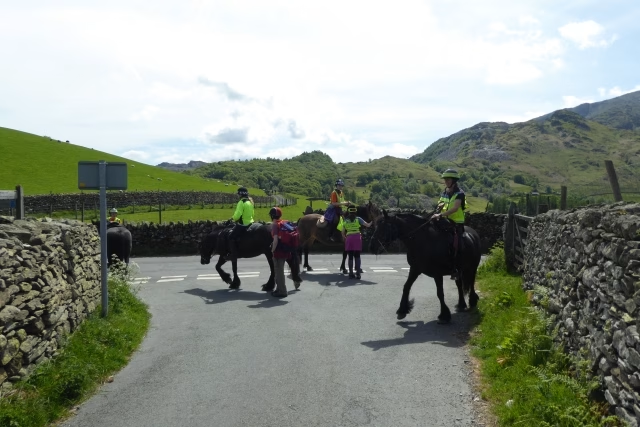
Photographs: A group of riders on a lane between stone walls in the Lake District by DS Pugh, CC BY-SA 2.0, via Wikimedia Commons.