
Horse riding · England
Horse Riding Kent Routes, Rules and Access
Kent riding runs along bridleways, byways and gravel tracks through the Kent Downs and Forestry England woods. Riders may use bridleways, restricted byways and byways but not footpaths, and Thanet beaches close to horses on summer days.
At a glance
Riding in Kent in brief
- AccessBridleways, restricted byways and byways; footpaths are for walkers only
- TerrainThe Kent Downs describes Kent as a gentler landscape of quiet lanes and gravel tracks
- Riding level
Beginners on a guided ride to confident riders on their own horse - Where to rideThe Kent Downs, Forestry England woods at Bedgebury, Hemsted, Clowes Wood and King's Wood, and some beaches
- Long-distance routeNorth Downs Way Riders' Route, linking bridleways, byways and quiet roads
- Beach ridingThanet bans horses on beaches from 1 May to 30 September between 9am and 7pm
- Winter groundThe Kent Downs says the trail can get quite muddy in winter
- Stay with your horseForestry England equestrian parking is for unloading only, with no overnight parking
Where to ride
Where to ride in Kent
Kent offers riding on public bridleways across the county, on the Kent Downs, in four Forestry England woods and on a few beaches under local rules.
Kent County Council publishes a horse riding guide that names several recommended areas, including Wye and Crundale, Freedown and Dry Hill. It also lists country parks with riding routes, such as Lullingstone, Shorne Wood and Trosley, and some need a permit. The guide carries no date, so check each park with its own manager.
The Kent Downs National Landscape is a designated Area of Outstanding Natural Beauty. It stretches from the white cliffs of Dover to the Surrey and London border and lists horse riding as one of its three main activity types, alongside walking and cycling.
Four Forestry England woods in Kent have marked equestrian routes and a parking area where you can unload. They are Bedgebury Forest, Hemsted Forest, Clowes Wood and King's Wood, and the woods and beaches section below sets out the rules for each.
Rights and rules
Rules and rights of way for riders in Kent
The British Horse Society says that riders may use bridleways, restricted byways and byways open to all traffic, and that footpaths are for walkers only.
Kent County Council gives the same answer in its riding guide, which says that riders may use bridleways, restricted byways and byways. It asks you to follow the Highway Code on roads and to ride on the left, no more than two abreast. It also asks you to wear hi-visibility clothing and to avoid riding in fog or darkness.
Kent County Council runs a public rights of way map. You can search by town or postcode and filter the result by footpaths, bridleways, restricted byways, byways or promoted routes. The British Horse Society says the Definitive Map is the legal record of public rights of way. It adds that any map may not be completely up to date, so unrecorded routes will not appear on your Ordnance Survey map either.
Explore Kent says that registered common land and some downland count as open access land, which you can use without sticking to paths. No official page confirms that open access land in Kent is open to horses, so treat a common or down as closed to riders unless a sign, a bridleway or the landowner says otherwise.
Long-distance route
North Downs Way and the Riders' Route
The North Downs Way National Trail runs 153 miles from Farnham in Surrey to Dover in Kent, and the official trail website describes a separate Riders' Route for people on horseback.
The official trail website says the trail was enhanced through the Riders' Route so that it can be explored on two wheels or on horseback. The Kent Downs National Landscape gives the Riders' Route as about 169 miles from Dover. Cycling UK, which proposed the route with the British Horse Society, gives 171 miles, so the exact figure differs by source.
Cycling UK says the Riders' Route links bridleways, byways and quiet roads so that it avoids footpath sections, because the original trail could not be cycled from end to end. The official trail website does not say which stretches of the main trail line are open to riders, so follow the Riders' Route instead of the main line unless a local source tells you otherwise.
The Kent Downs adds that for horse riders further consultation work is under way to enhance the route, and it advises riders to assess the routes against their own requirements and knowledge. It names an East Kent Loop that covers Canterbury, Chilham, Dover, Godmersham and Wye. The Kent half is gentler, with quiet lanes and gravel tracks, though the trail can get quite muddy in winter.
Woods and beaches
Forestry England woods and beaches in Kent
Forestry England asks for no riding permit at its Kent woods, but it limits where you may ride and where you may unload.
At Bedgebury Forest it says riders should stay on the designated horse riding trails, which cover more than 8 miles of bridleways and 7 miles of waymarked trails. Riding is not permitted in the National Pinetum or the Conifer Conservation Project. At King's Wood near Challock it says riders may leave the bridleway on gravel tracks only, across a network of 7.56 miles. At Hemsted Forest it says the same for nearly 400 hectares of woodland.
Forestry England asks you to use the designated equestrian-only parking area to unload. It requires an equestrian parking pass for that area, and the same pass covers Clowes Wood, where riding follows bridleways and gravel tracks. Its parking is for horses only, overnight parking is not allowed, and spaces are not guaranteed.
Kent County Council's older riding guide says Forestry Commission bridleways must not be left without a permit. The current Forestry England pages say that no permit is needed from Forestry England or TROT at these woods, so we follow the current pages.
On the coast, Thanet District Council bans horses on beaches and promenades from 1 May to 30 September between 9am and 7pm, and bans them at Pegwell Bay all year. Its byelaws say that outside those dates horses are allowed at any time. Other stretches of coast fall under other authorities whose rules are not confirmed here, so check with the council that manages the beach before you ride.
Seasons
When is the best time to ride in Kent?
No official body names a single best month for Kent, but two published limits shape the calendar: the Thanet beach hours and winter mud on the downs.
The Thanet restriction means that from 1 May to 30 September your beach ride has to finish before 9am or start after 7pm. From 1 October to 30 April the same beaches carry no such limit, though you should still look for local notices.
The Kent Downs says the North Downs Way can get quite muddy in winter. In wet weather you may want shorter days, or the bridleways and gravel tracks inside the Forestry England woods.
No official page gives hunting or shooting dates for Kent bridleways, so they are left out.
Your own horse
Can you take your own horse to Kent?
Yes, you can bring your own horse to Kent, and the main plans are where your lorry will stand and where your horse will sleep.
Forestry England says its equestrian parking is for unloading horses only, that horseboxes must stay in the designated area and that no vehicle may stay overnight. No official page gives figures for stabling or grazing in Kent, so ask a local yard or livery before you commit.
GOV.UK says that you must keep a valid horse passport with your animal at all times, including when you move it. A fine is possible if you cannot show one.
Taffy, a Welsh cob, Jasmine, a Shetland pony, and Polly, a moorland pony, live on our own land at Noonvares Farm near Hayle in Cornwall. For our own horses we check where the stable or field is, how the fencing looks, where the lorry will stand and what the first mile from the gate is like. A vet decides for an individual horse, so find the local equine vet before you set off.
Common questions
Questions about horse riding in Kent
Can you ride on footpaths in Kent?
No. The British Horse Society lists footpaths as open to walkers only. Riders may use bridleways, restricted byways and byways open to all traffic, and roads other than motorways. Kent County Council's rights of way map lets you filter by route type before you set out.
Do you need a permit to ride in Kent's Forestry England woods?
Forestry England says that no permit is required from it or from TROT at Hemsted Forest and King's Wood, and Bedgebury's routes are likewise accessible without one. Parking is separate, because unloading in the equestrian-only area needs an equestrian parking pass.
Can you ride on the beach in Kent in summer?
Not in Thanet during the day. Thanet District Council bans horses on beaches from 1 May to 30 September between 9am and 7pm. Outside those hours and dates they are allowed, but Pegwell Bay is closed to riding all year. Check other beaches with their own council.
Is the whole North Downs Way open to horses?
No official page confirms that. The official trail website describes a Riders' Route for horseback, and Cycling UK says the original trail included footpath sections. Plan your ride on the Riders' Route and check each stretch with Kent County Council's map.
How do you find bridleways in Kent?
Use Kent County Council's public rights of way map, which you can search by town or postcode and filter by bridleways, restricted byways and byways. An Ordnance Survey Explorer map at 1:25,000 shows field boundaries and routes from the Definitive Map.
Can your horsebox stay overnight at a Kent forest car park?
No. Forestry England says no vehicle may park overnight in its equestrian parking, which is for unloading horses only. Spaces are not guaranteed, so have a second option for stabling or a field near the woods.
Where to go next
Where next
Ride in Kent
Tell us your dates and your level, and we will point you towards the right ride, whether you hire a horse locally or bring your own.
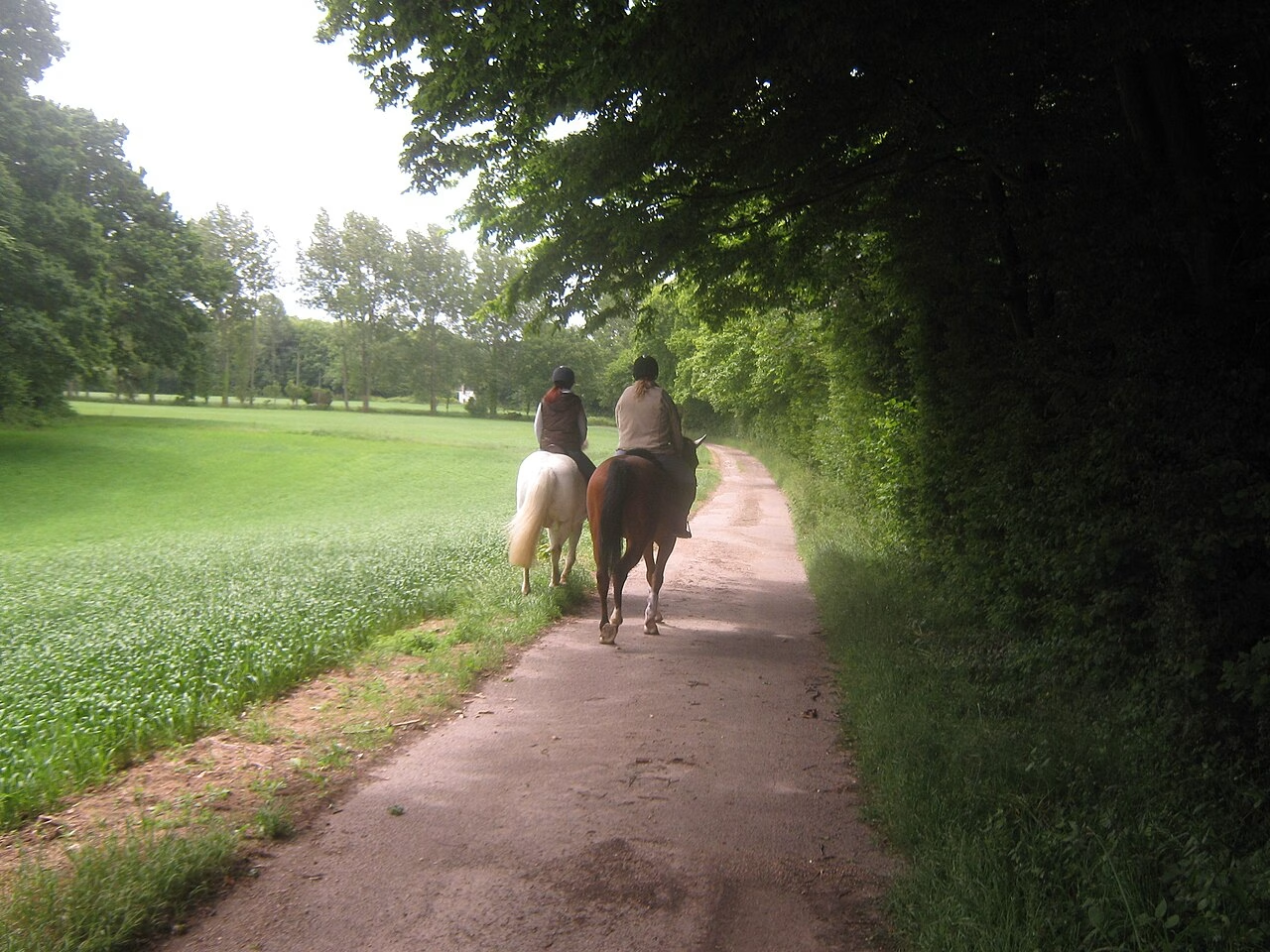
Photographs: Two riders on a farm track beside a field in Kent by David Anstiss, CC BY-SA 2.0, via Wikimedia Commons.