
Horse riding · England
Horse Riding Exmoor Rules and Routes
Exmoor riding follows over 300 miles of bridleways across open moorland, woodland and farmland in Somerset and Devon. Exmoor National Park Authority allows horses on bridleways and restricted byways but not footpaths, and access land is for walkers.
At a glance
Riding on Exmoor in brief
- AccessBridleways and restricted byways; public footpaths are for walkers only
- TerrainOpen moorland, woodland tracks, farmland fields and country lanes
- Riding level
Novices on a guided hack to experienced riders on their own horse - Where to rideOver 300 miles of bridleways, according to Exmoor National Park Authority
- WaymarksBlue for bridleways, purple for restricted byways, yellow for footpaths
- Access landWalking only by right; ride the bridleway line that crosses it
- River fordsBarle fords between Withypool and Tarr Steps are for low water only
- Sharing the moorPonies and farm stock graze the commons; shut the gates
- Horse passportA valid passport travels with your horse at all times
Where to ride
Exmoor bridleways and moorland routes
You can ride on Exmoor along its public bridleways, which Exmoor National Park Authority puts at over 300 miles, crossing open moorland, woodland tracks, farmland fields and country lanes.
The Authority describes a park of 267 square miles and says that over 60 per cent of its public rights of way carry bridleway or higher rights. Its page for groups adds nearly 1,000 kilometres of public rights of way in all. It also lists another 340 kilometres of permitted paths, which a landowner allows people to use.
The Authority names no set routes on its riding page. It points riders to the current Ordnance Survey Explorer map, and its Access and Recreation Map shows public rights of way and permissive paths. Work from the map, because a day's ride needs the line of each bridleway.
The Authority also says that coming across livestock is a regular occurrence, so expect gates, cattle and sheep on most rides.
The Two Moors Way runs for 102 miles from Ivybridge on Dartmoor to Lynmouth on the Exmoor coast, according to the route's own website. That website says nothing about horses, so a right for riders to follow it is unconfirmed, and each stretch needs checking against the map. It also warns that its moorland sections are not signed.
Rights of way
Which paths a horse may use
A horse may use public bridleways and restricted byways on Exmoor, and may not use public footpaths, according to the rights of way guidance of Exmoor National Park Authority.
The Authority marks them by colour. Yellow waymarks show a footpath, which is for walkers only. Blue shows a public bridleway, open to walkers, horse riders and cyclists. Purple shows a restricted byway, which also admits carriage drivers. The Countryside Code adds a red arrow for a byway open to all traffic. It describes this as a recorded right of way for all users including motorised vehicles, so expect traffic.
The Authority's group page states that bicycles and horses are not allowed on public footpaths by right. Permitted paths are different, because the Authority says they are available by landowner permission rather than by legal right. A general rule on horses is unconfirmed, so check the sign or the Access and Recreation Map before you ride one.
Public rights of way cross the River Barle between Withypool and Tarr Steps. The Authority warns that most of these are at fords that are not safe to cross unless on horseback, and that even then you would only attempt them in low water conditions.
Paths close from time to time, and the Authority advises you to check its Path News page for a list of legal closures before you set out.
Open land
Access land and commons on Exmoor
Open access land on Exmoor is a right for walkers, and Exmoor National Park Authority says that horse riding is not permitted on it by the Countryside and Rights of Way Act.
The Authority adds that in some places open access rights may extend to other users such as horse riders. It does not say where, so keep to a bridleway, restricted byway or signed path unless a sign or the Access and Recreation Map says otherwise.
About a quarter of Exmoor is open access land, the Authority's group page says, and Ordnance Survey Explorer maps show it in a yellow colour wash. Not all of it is signed. A bridleway that crosses access land is still a bridleway, so you may ride that line. The Authority says landowners can restrict access for up to 28 days each year. Closures or restrictions do not affect public rights of way.
The ponies of Exmoor graze the commons, and many commons share boundaries. The Authority's pages confirm no general right to ride across the commons, so stay on the bridleways that cross them.
The National Trust describes the 150 miles of footpaths and bridleways on its Holnicote Estate as suitable for walking, horse riding and cycling, but that page gives no rule specific to horses. The Forestry England announcement on 49 more woodlands open to riders without a permit does not name Exmoor, Devon or Somerset, so a Forestry England rule on Exmoor is unconfirmed.
Rider level
Exmoor riding for each level
Exmoor suits riders from novice to experienced, because the Authority describes its bridleways as offering riders of all abilities.
It suits you if
- Novices who book a guided hack with a licensed local centre
- Confident riders who can read an Ordnance Survey map and manage gates from the saddle
- Riders on a horse that is settled around cattle, sheep and ponies
It is not for you if
- Riders who plan to canter across open access land away from a bridleway
- Riders who would cross the Barle fords in high water
- Riders on a horse that panics near livestock
A novice is usually best served by a guided hack from a licensed riding centre or trekking centre nearby, which matches you to a horse that knows the ground. Ask about the length of the ride, the experience of the horses and the weight limit before you book. Limits vary between centres, so we leave out a figure.
A confident rider on their own horse will meet livestock, gates, open moorland and fords, so carry the Ordnance Survey Explorer map that the Authority recommends. The West Somerset and Exmoor Bridleways Association is an equestrian access group affiliated to the British Horse Society, and it says it organises group rides open to members and non-members.
Seasons
When is the best time to ride on Exmoor?
Late spring to early autumn is our choice for riding on Exmoor, but no official body publishes a riding season, so this is our judgement and not a rule.
Three official points shape the calendar. Exmoor National Park Authority says that swaling, the controlled burning of heather moorland, is normally carried out between 1 October and 15 April. It recommends no swaling after the end of March, to protect nesting birds. Expect burning on the heather in those months.
The Authority says the Barle fords are only attempted in low water conditions, which points to drier spells. It also advises you to check its Path News page for legal closures before each ride.
No hunting restriction on riders is confirmed on the official pages. The Authority's hunting FAQ says only that hunt groups are asked to minimise the impact on other users of public rights of way.
Ponies and stock
Exmoor ponies, livestock and gates
Expect Exmoor ponies and farm animals on the moor, and keep to the bridleway and shut the gates.
The Authority says that around twenty herds of Exmoor ponies run on the commons, that two of them are owned by the National Park and that every pony belongs to someone. It calls them wild only in the sense that the herds roam freely on the moor.
It asks visitors never to try to feed or touch the ponies, and to close the gates because many commons share boundaries. The Countryside Code says to leave gates as you find them. It also says to give wild animals, livestock and horses plenty of space and not to feed them. Where the two seem to differ, follow any sign on the gate.
The Authority also publishes a tick awareness page, which says that ticks can spread potentially serious illnesses such as Lyme disease.
Your own horse
Can you take your own horse to Exmoor?
Yes, you can ride your own horse on the bridleways and restricted byways of Exmoor. The Authority's riding page mentions no permit. Its group page states no notification or registration requirement for riding groups, although overnight camping needs landowner permission.
The official pages give no figures for stabling, grazing or lorry parking, so ask a licensed local yard or livery before you commit, and ask where a lorry can stand at the start of your route.
GOV.UK says that you must keep a valid horse passport with your animal at all times, including when you move it.
Taffy, a Welsh cob, Jasmine, a Shetland pony, and Polly, a moorland pony, live on our own land at Noonvares Farm near Hayle in Cornwall. For our own horses we check where the stable or field is, how the fencing looks, where the lorry will stand and what the first mile from the gate is like. A vet decides for an individual horse, so find the nearest equine vet before you set off.
Common questions
Exmoor riding questions
What do the blue and purple waymarks mean for riders?
Exmoor National Park Authority says blue marks a public bridleway, open to walkers, horse riders and cyclists, and purple marks a restricted byway, which also admits carriage drivers. Yellow marks a footpath, which is for walkers only.
Is it safe to cross the River Barle fords on a horse?
The Authority says most fords between Withypool and Tarr Steps are not safe to cross unless on horseback, and that even then you would only attempt them in low water conditions. Check the water before you commit.
Do you need to register before a ride on Exmoor?
The Authority's group page states no notification or registration requirement for riding groups. It does say overnight camping needs landowner permission. Nothing further is confirmed, so ask the landowner where you plan to cross private ground.
Can you feed or touch the Exmoor ponies?
No. The Authority says never to try to feed or touch the ponies. The Countryside Code also asks you to give wild animals, livestock and horses plenty of space and not to feed them.
Where do you find out about path closures on Exmoor?
The Authority runs a Path News page and advises you to check it for a list of legal closures. Closures to access land do not affect public rights of way, according to the Authority.
Does a horse need a passport to travel to Exmoor?
Yes. GOV.UK says you must keep a valid horse passport with your animal at all times, which includes when you move it. You can be fined if you cannot show a valid passport.
Where to go next
Where next
Ride on Exmoor
Tell us your dates and your level, and we will point you towards the right ride, whether you hire a horse locally or bring your own.
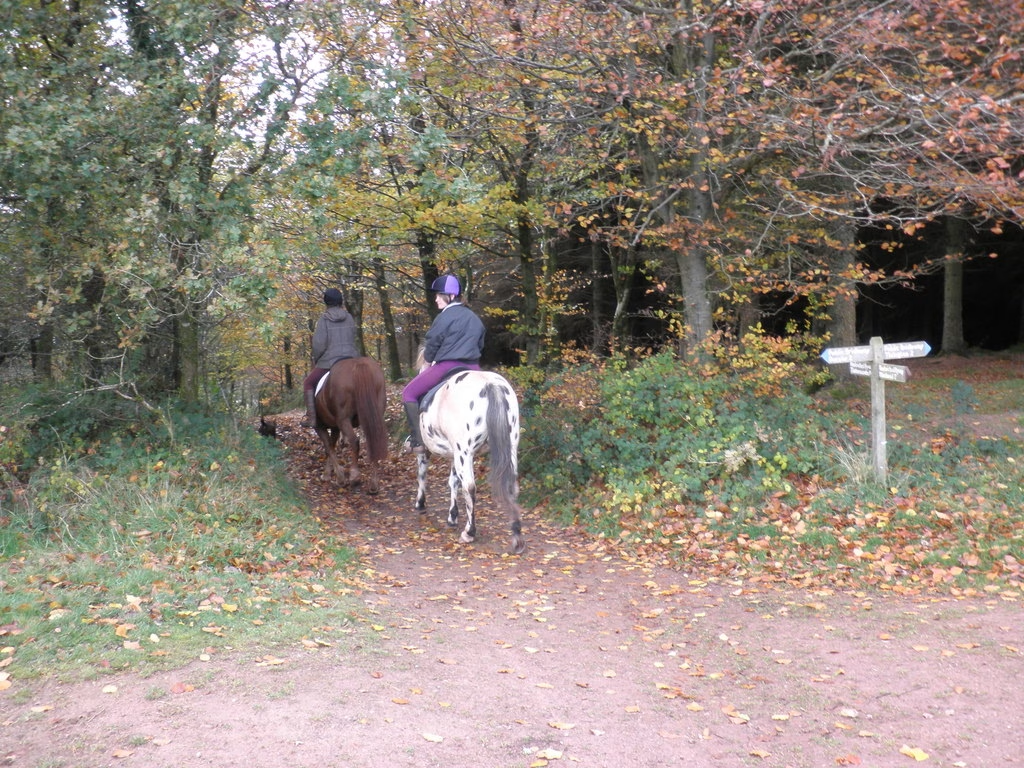
Photographs: Two riders at a signpost junction in autumn woodland by Roger Cornfoot, CC BY-SA 2.0, via Wikimedia Commons.