
Horse riding · England
Cannock Chase Horse Riding
Cannock Chase riding follows bridleways and forest roads through pine forest, birch woodland and open heathland in Staffordshire. Forestry England asks for no permit, but the Chase is busy with walkers, cyclists and dogs.
At a glance
The short answer
- Quietest timesQuietest in school term time; at weekends and school holidays, Forestry England suggests before 10am or after 5pm
- Riding level
Beginners on a guided ride to confident riders on their own horse - TerrainPine forest, birch woodland and open heathland
- Where to rideBridleways and forest roads; two routes start at Milford Common and two at Seven Springs
- AccessNo permit needed on Forestry England land; stay on bridleways
- Stay with your horseNo designated horsebox parking; riders use the surrounding car parks
Where to ride
Where to ride on Cannock Chase
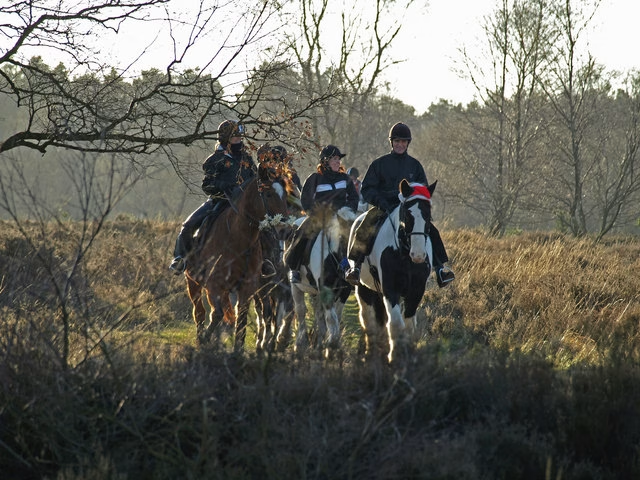
You can ride along the bridleway network and the forest roads of Cannock Chase, which take in pine forest, birch woodland and open heathland in Staffordshire.
The Cannock Chase SAC Partnership describes an extensive bridleway network of 82 miles for riders. Forestry England says that there are no designated horse riding trails. Riders use the ordinary bridleways and forest roads, which it describes as wide enough for a rider accompanied on foot.
The Cannock Chase National Landscape website lists four marked riding routes, two from Milford Common car park and two from Seven Springs car park. The leaflet for the Milford Common pair gives a purple route of 14 km along Chase Road, Camp Road and the Heart of England Way. Its blue route of 17 km runs on through Abrahams Valley to Seven Springs, around Brocton Coppice and through the German Cutting.
Riders usually park at the Punch Bowl, Seven Springs, Whitehouse, Penkridge Bank or Milford Common car parks, according to the National Landscape website. It shows bridleways as long green dashes on Ordnance Survey Explorer map 244.
Rights and rules
The rules for riding on Cannock Chase
You may ride on public bridleways and the forest roads. The main rule from the Cannock Chase SAC Partnership is to stick to bridleways and keep your horse's hooves on the paths at all times, which protects the rare species of the Chase.
The National Landscape website explains that horse riding is not allowed on access land unless the landowner allows it or public bridleways cross the land. It marks a bridleway with a blue arrow as a recorded right of way for walkers, horse riders and cyclists. A footpath with a yellow arrow is for walkers only.
Forestry England says that no permit is required to ride at Cannock Chase Forest. It asks riders to keep out of the busier woodland around the main visitor centre and to avoid the cycle trails. It also advises you to visit the visitor information point before you unload, to check for forest works, large events or areas to avoid.
The leaflet from the Cannock Chase National Landscape team, printed by Staffordshire County Council, asks riders to use only bridleways and designated concessionary routes. Stay off private land and choose another route when the ground is very wet. Both Milford Common routes pass a Phytophthora disease hot spot at Camp Road, and the leaflet says to wash and brush your horse's hooves if it leaves the tracks.
The Cannock Chase SAC Partnership also covers dogs. A dog that rides out with you must be under control with excellent recall. Dogs must be on a lead from 1 March to 31 July on Open Access Land, which covers most of the Chase.
Rider level
Horse trekking for beginners on Cannock Chase
Yes, beginners can go horse trekking on Cannock Chase. The sensible route for a new rider is a guided ride from a licensed trekking centre or riding school rather than a first outing alone.
It suits you if
- Beginners who book a guided ride with a licensed trekking centre
- Confident riders who like forest tracks and open heath
- Riders who bring a settled horse that is used to cyclists and dogs
It is not for you if
- Riders who want a quiet empty forest at a weekend midday
- Riders on a horse that spooks easily at bikes, with no plan for off-peak times
- Riders who hope to roam off the bridleways across open heath
The Cannock Chase National Landscape website says that local trekking centres offer tuition and guided rides. Ask any centre about the length of the ride, the experience of the horses and its own weight limit before you book. Published weight limits vary by centre, so we leave a single figure out.
If you search for horse trekking near Cannock Chase, a centre will usually ask your height, weight and riding experience. It then matches you to a horse on that basis. Confident riders who bring their own horse can use the bridleways without a guide, as long as they carry a map and follow the rules above.
When to go
When is the best time to ride on Cannock Chase?
The quietest time to ride on Cannock Chase is during school term time. Forestry England recommends riding before 10am and after 5pm at weekends and in school holidays, when the forest is at its busiest.
Forestry England explains that the main car park can be very busy at weekends and in school holidays, which makes boxing in a horse harder. An off-peak start is kinder to you and to your horse.
The leaflet for the Milford Common routes asks riders to pick another route when the ground is very wet, to avoid churning up the paths. The National Landscape website has also warned that the naturally dry heathland and ancient woodland are extremely vulnerable to wildfire, so check its news before a summer ride.
Autumn brings the rut, the deer mating season, and the Cannock Chase SAC Partnership asks everyone to give deer plenty of space. A horse that has not met deer before is best introduced to them calmly and at a distance. If you ride in autumn, you will want a bright jacket and a calm horse, and you can check the day's conditions with Forestry England before you set out.
Your own horse
Can you bring your own horse to Cannock Chase?
Yes, you can bring your own horse to Cannock Chase. The main thing to plan is where the lorry will stand, because Forestry England says that there is no designated horsebox parking.
Forestry England advises horseboxes to use the quieter car parks around the main one. The National Landscape website names the Punch Bowl, Seven Springs, Whitehouse, Penkridge Bank and Milford Common car parks as places riders typically park. The sources give no height barriers or space for a larger lorry, so ring ahead or look at each car park before you travel.
GOV.UK says that you must keep a valid horse passport with your animal at all times, including at its stable and when you move it.
Taffy, a Welsh cob, Jasmine, a Shetland pony, and Polly, a moorland pony, live on our own land at Noonvares Farm near Hayle in Cornwall. For our own horses we check where the stable or field is, how the fencing looks, where the lorry will stand and what the first mile from the gate is like. A vet decides for an individual horse, so find out the local equine vet before you set off.
Beyond the saddle
More to do on Cannock Chase
Cannock Chase is a small and protected landscape in Staffordshire, and it is home to fallow deer and red deer that you may see from the saddle.
The Cannock Chase National Landscape site gives its size as 26 square miles, or 68 square kilometres. That makes it the smallest mainland National Landscape in England. It was formerly an Area of Outstanding Natural Beauty and was renamed a National Landscape in November, a change that applied to all such areas in England and Wales. The site cites the natural beauty of its heaths, forests and historic parkland.
The Cannock Chase SAC Partnership says that fallow deer are the most common deer species on the Chase, and that red deer are mostly found on the southern half. About 150 deer die on the roads of the Chase each year. Drive slowly at the 40mph advisory limit, especially at dawn and dusk in autumn and spring.
Common questions
Questions about horse riding on Cannock Chase
Do you need a permit to ride on Cannock Chase?
Forestry England says that no permit is required to ride at Cannock Chase Forest. It asks riders to stay out of the busier woodland around the main visitor centre, to avoid the cycle trails and to check the visitor information point for forest works before unloading.
Are there marked horse riding trails?
Forestry England says that there are no designated horse riding trails. The Cannock Chase National Landscape website does list four riding routes, two from Milford Common and two from Seven Springs, which follow the ordinary bridleways.
Can you ride a horse on a footpath?
No. The Cannock Chase National Landscape website describes a footpath, marked with a yellow arrow, as a recorded right of way for walkers and mobility aid users. A bridleway, marked with a blue arrow, is open to horse riders as well.
How long are the riding routes from Milford Common?
The leaflet from the Cannock Chase National Landscape team gives two routes that start and finish at Milford Common car park. The purple route is 14 km and the blue route is 17 km, and the blue route continues through Abrahams Valley to Seven Springs.
What should you do about disease on the paths?
The leaflet from the National Landscape team says that both Milford Common routes pass a Phytophthora disease hot spot at Camp Road. If your horse leaves the tracks, wash and brush its hooves to remove mud and spores.
Can you take a dog riding on Cannock Chase?
The Cannock Chase SAC Partnership says that a dog must be under control with excellent recall, because other dogs are common. Dogs must be on a lead from 1 March to 31 July on Open Access Land, and on a lead around livestock at all times.
Where to go next
Where next
Ride on Cannock Chase
Tell us your dates and your level, and we will point you towards the right ride, whether you hire a horse locally or bring your own.
Photographs: Riders near Chase Corner car park on the north side of the Chase by Tim Marshall, CC BY-SA 2.0, via Wikimedia Commons.